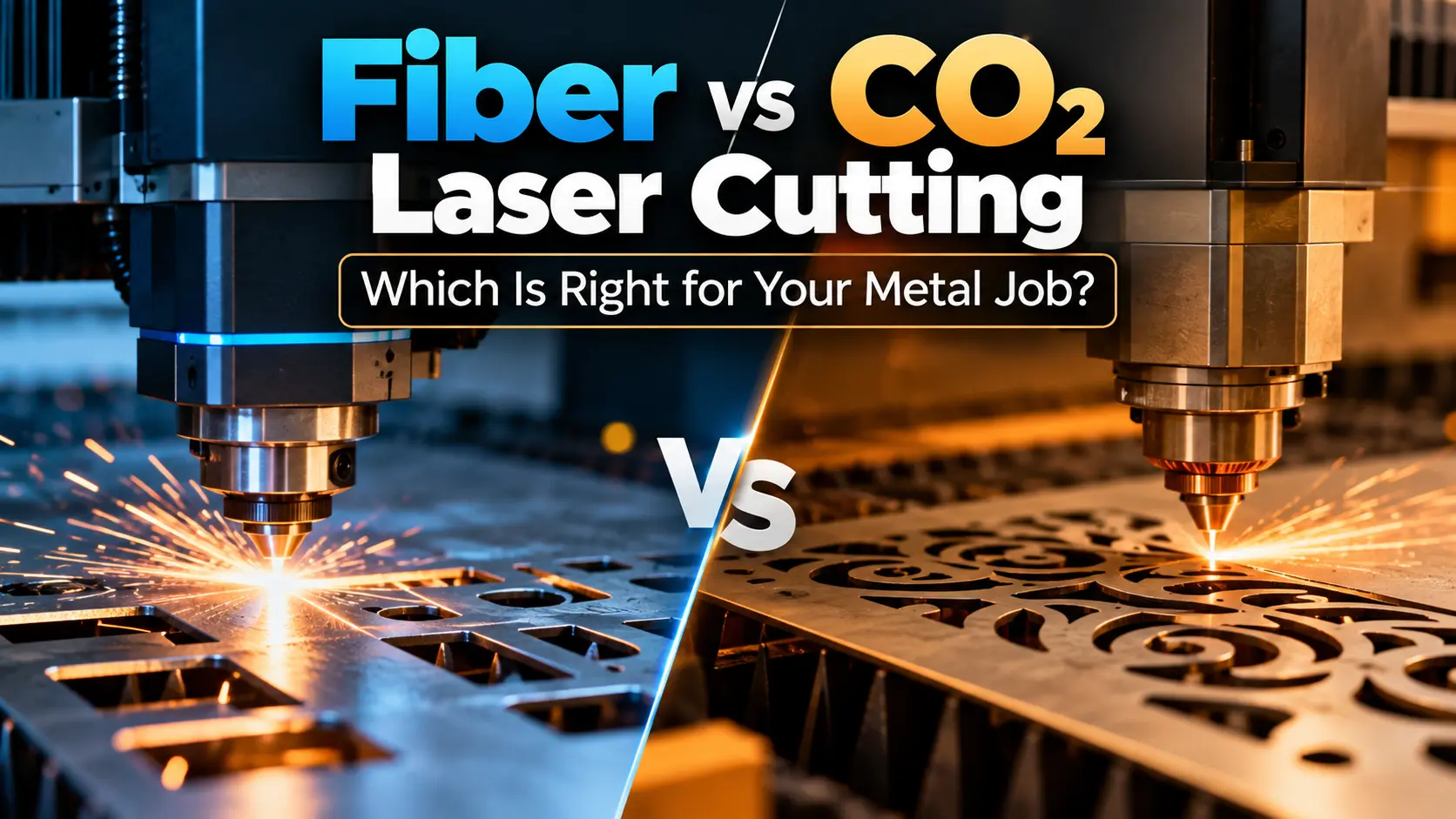
Choosing between a fiber laser cutting machine and a CO2 laser cutting machine is a decision that costs lakhs and gets argued about on every shop floor – and most of the arguments skip past the one thing that actually matters: what you’re cutting. This guide compares fiber and CO2 laser machine cutting specifically for metal work, cuts through the physics debate, and ends with a straightforward table to help you pick for your job.
How Laser Cutting Works (and Where CNC Fits)
Every laser cutting machine works the same basic way: a focused beam melts or vaporises material along a programmed path, while an assist gas (usually oxygen, nitrogen, or compressed air) blows the molten material out of the kerf as the beam moves. What differs between machine types is the source that generates the beam.
The “CNC” in a CNC laser cutting machine refers to the computer-control layer that drives the cutting head – reading your design file, positioning the head, and managing cutting speed and gas flow. CNC isn’t a laser type; it’s the control system. Both fiber and CO2 machines are sold as CNC laser cutting machines, so seeing that term on a spec sheet doesn’t tell you which laser source you’re getting. The variable that actually decides performance, and the one this guide focuses on, is the beam’s wavelength.
What Is a Fiber Laser Cutting Machine?
A fiber laser cutting machine generates its beam in a solid-state fiber optic medium rather than a gas tube, producing a short wavelength of around 1.06 micrometres. Metals absorb that wavelength far more efficiently than they absorb longer wavelengths, which is the core reason fiber has become the default choice for metal fabrication.
Fiber laser cutting machines perform best on steel, stainless steel, aluminium, copper, and brass, handling thin to medium gauges well – broadly from foil-thin sheet up to roughly 20–25mm on higher-power industrial machines. Their strengths compound from there: they cut noticeably faster than CO2 on thin and medium metal, run at roughly half the operating cost thanks to higher electrical efficiency, need minimal maintenance since there are no mirrors to align or gas to refill, and typically carry a rated life around 100,000 hours.
They’re not universally superior, though. Upfront machine cost is generally higher than a comparable CO2 unit, and fiber loses its advantage on very thick plate and on non-metal materials, where it performs poorly or not at all.
What Is a CO2 Laser Cutting Machine?
A CO2 laser cutting machine generates its beam by exciting a gas mixture inside a sealed tube and directing it through a series of mirrors to the cutting head. That process produces a much longer wavelength – around 10.6 micrometres – which organic and non-metal materials absorb very effectively.
This makes CO2 the stronger choice for wood, acrylic, plastics, textiles, and glass, where it delivers clean, smooth edges, including on thicker non-metal sections where fiber struggles. CO2 machines also remain genuinely useful on certain thick-plate metal jobs and come with a lower upfront purchase price, which keeps them relevant rather than obsolete.
On metal specifically, though, CO2 shows real downsides: reflective metals like copper, brass, and aluminium can reflect the beam back toward the source, causing cutting difficulty and even equipment damage; cutting speed on thin metal sheet lags well behind fiber; and the gas-tube design means more routine maintenance, including mirror alignment and gas replenishment.
Fiber vs CO2 for Metal: The Head-to-Head
For pure metal laser cutting machine work, fiber wins on nearly every practical measure that affects a shop’s bottom line: cutting speed on thin and medium gauge, running cost per hour, and maintenance burden all favour fiber, and it handles reflective metals like copper and brass without the reflection risk that troubles CO2 sources. CO2 only pulls ahead in two narrow cases – when a shop regularly cuts non-metal materials alongside metal, or when very thick plate work makes CO2’s thick-section performance and lower machine cost more attractive than fiber’s speed advantage. The table below lays out the trade-offs a metal buyer actually needs to weigh.
Factor | Fiber laser | CO2 laser |
Best materials | Steel, stainless steel, aluminium, copper, brass | Wood, acrylic, plastics, textiles, glass; some thick metal |
Metal thickness range | Thin to roughly 20–25mm (higher on industrial-power machines) | Handles thick plate well; slower on thin metal |
Cutting speed on thin metal | Faster | Slower |
Reflective metals (copper, brass) | Handles well | Reflection risk; can damage the source |
Running / energy cost | Lower – roughly half of CO2 in typical use | Higher |
Maintenance | Minimal – no mirrors or gas refills | More frequent – mirror alignment, gas handling |
Typical lifespan | Around 100,000 hours (source) | Shorter tube life; tubes need periodic replacement |
Upfront cost | Higher | Lower |
Which Should You Choose for Your Metal Job?
The right pick comes down to three questions: what material are you cutting, how thick is it, and what’s your production volume? Answer those honestly and the decision table below does most of the work. For a shop that only ever touches metal, fiber is the default – the speed and running-cost advantage compounds fast at any real volume. CO2 earns its place when non-metal materials are genuinely part of the job mix, or when very thick plate work makes its economics competitive.
Your job | Recommended | Why |
Thin sheet-metal parts (brackets, panels, enclosures) | Fiber | Faster cutting, lower running cost at volume |
Reflective metal (copper, brass) | Fiber | Avoids reflection risk that troubles CO2 sources |
Thick mild-steel plate | Either, evaluate case-by-case | CO2 stays competitive on thick sections; fiber narrows the gap at higher power |
Mixed metal + non-metal work | CO2 | Only CO2 handles wood/acrylic/textiles alongside metal |
High-volume metal production | Fiber | Lower running cost and higher speed compound over volume |
Occasional, hobby, or signage work | CO2 | Lower upfront cost fits lighter, irregular use |
Cost, Power and Service in India
For Indian buyers, the fiber-vs-CO2 decision usually comes down to upfront cost versus running cost. Fiber laser cutting machines carry a higher purchase price than comparable CO2 units, but their lower running cost – driven by higher electrical efficiency – tends to pay that difference back over time, especially at steady production volume.
Electricity efficiency is worth weighing carefully given Indian industrial power tariffs – a fiber machine’s lower power draw per cut can meaningfully affect operating cost over a multi-shift production schedule, though exact savings depend on your local tariff structure and machine wattage.
Beyond the machine itself, factor in the availability of local service, spare parts, and trained operators in your region – a highly efficient machine that sits idle for weeks waiting on a spare part or a qualified technician erodes any cost advantage on paper.
Buy a Machine or Use a Laser Cutting Service?
Not every metal shop needs to own a laser cutting machine at all. If your volume is steady, you need tight control over turnaround, and you have the floor space and a trained operator, buying makes sense – you control scheduling and quality without depending on an outside vendor’s queue.
If your volume is low or unpredictable, you’re testing demand for a new product line, handling one-off jobs, or simply don’t have the capital appetite for a machine purchase right now, using a laser cutting service is usually the smarter move. You get access to industrial-grade cutting without the upfront investment, maintenance responsibility, or operator hiring that comes with ownership.
Conclusion
For metal work, the verdict is straightforward: a fiber laser cutting machine is the right default, and CO2 only makes sense once non-metal materials or very thick plate enter the picture. Use the decision table above to match your specific job to the right choice, and if you’re weighing a purchase, a quick consultation can save you from guessing on power and thickness specs.