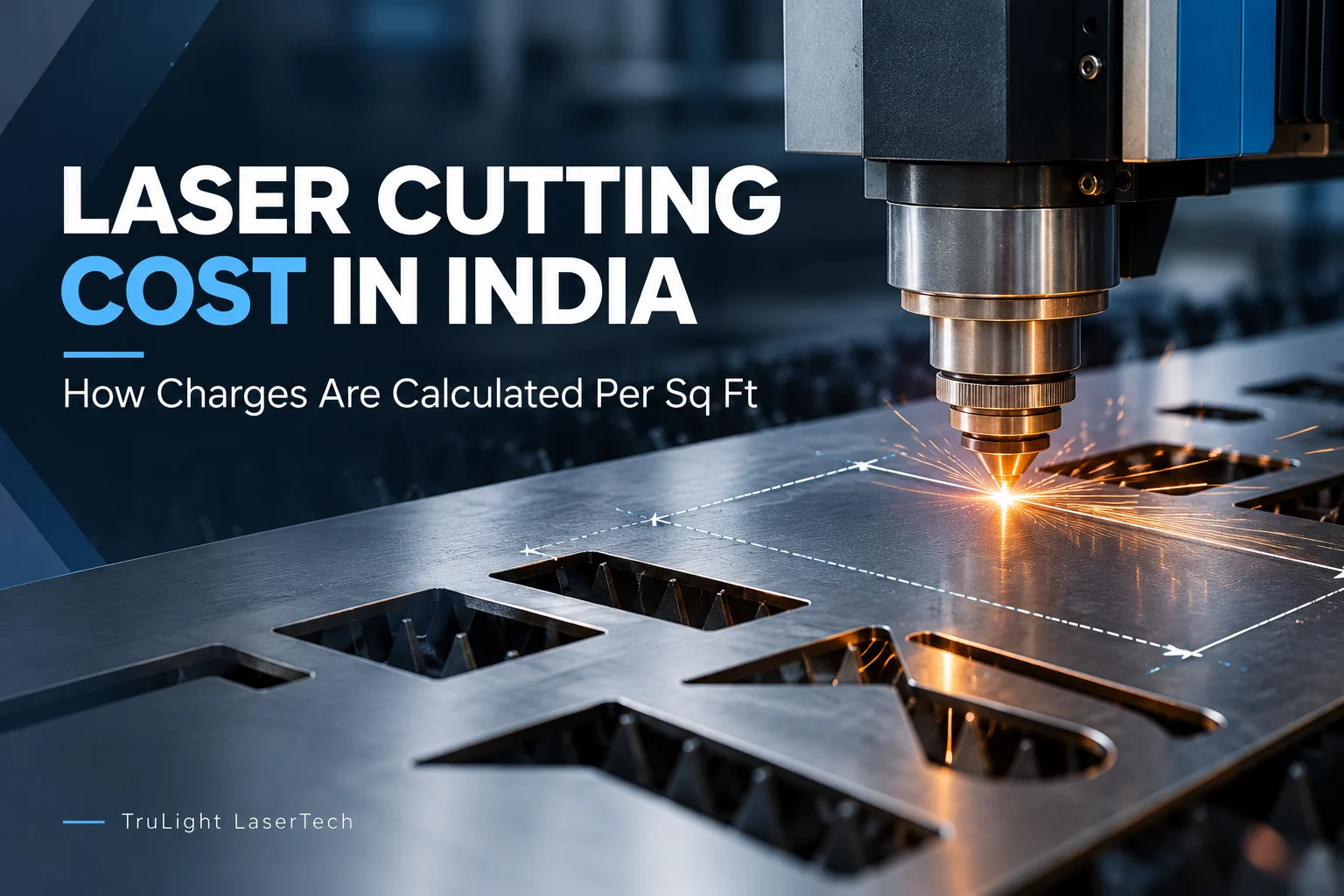
Navigating metal fabrication quotes is challenging when vendors use conflicting cost models, ranging from flat-rate square-footage fees to linear cut length, sheet thickness, or active machine run-time. Discrepancies between quotes rarely indicate errors; rather, each shop applies a different metric to account for material throughput, machine run-time, and tool wear.
The laser cutting cost usually depends on machine operating time, raw material, assist gas, setup, and the complexity of the design. Laser cutting economics hinge on machine shop overhead, sheet stock, kerf complexity, and assist gas selection, where switching from oxygen-assisted cutting to high-purity nitrogen for oxide-free edges significantly increases hourly burn rates. Recognizing these variables enables accurate apples-to-apples quote comparison.
This guide explains how laser cutting charges are calculated in India, when per-sq-ft pricing makes sense, how per-mm and per-cut rates work, and how to read a sample quote.
How Is Laser Cutting Cost Calculated in India?
At its core, fabricators aggregate resource expenditure, including machine duty cycles, material waste, gas volume, and labor, before mapping those inputs onto a standardized billing framework.
The Three Things Every Quote Is Really Pricing
Machine operating time
The laser machine needs time to pierce the sheet, follow the cutting path, and move between different parts of the design. Laser power, material thickness, and cutting speed affect this time.
Material and consumables
The cost of the metal sheet is separate from or included in the cutting charge, depending on the shop. Assist gases such as oxygen, nitrogen, or compressed air may also be used during cutting.
Setup and overheads
CAD/CAM programming, machine preparation, sheet loading, unloading, operator time and other shop expenses can be included in the rate or charged separately.
So, when considering how to calculate laser cutting charges, look beyond the headline rate. The final amount depends on what the quoted rate actually includes.
Why Two Shops Quote Different Rates for the Same Job
Two fabricators can quote different prices for the same drawing because their machines, operating costs, and pricing methods may differ.
A higher-power fiber laser may complete a job faster, while another shop may use a lower-power machine that takes longer. The choice of assist gas also affects operating costs. Material prices, shop location, production volume, and setup charges can further change the final quote.
Laser Cutting Charges Per Sq Ft Explained
Laser cutting charges per sq ft are useful when the job involves large sheets, panels or parts with relatively consistent cutting requirements.
Instead of calculating every machine movement and cutting operation separately, the fabricator gives you a rate based on the area being processed.
When Per Sq Ft Pricing Applies and When It Does Not
Per-sq-ft pricing works well for relatively simple panels, signage, architectural panels, structural plates, and repetitive parts.
It becomes less useful for highly detailed designs. Consider two sheets with the same area. One may have a simple rectangular outline, while the other contains hundreds of small holes. The second job can require much more piercing and machine movement.
This is why many fabricators pivot from area-based square-foot pricing to per-millimeter, per-cut, or machine-time billing when dealing with intricate geometries.
Before comparing a per-sq-ft quote, ask what the rate includes and whether there are additional setup or minimum-order charges.
How the Billable Area Is Measured
Billable area depends on the fabricator’s calculation method. Some shops may charge according to the material allocated to the job, while others may use the finished part dimensions or the sheet area used after nesting.
Scrap and border margins can also affect material consumption.
Ask the fabricator whether the quoted area refers to the finished component, the required sheet size, or the material consumed during nesting. This gives you a clearer basis for comparing quotations.
Per Sq Ft vs. Per mm vs. Per Cut vs. Per Minute
Depending on the fabricator’s primary billing unit, two identical job specifications can yield vastly different itemized line items.
Pricing Unit | What It Means | Best Suited To | What to Watch For |
Per Sq Ft | Charge based on the area processed or material allocated to the job. | Charge based on active machine operating time. | May not reflect the extra machine time required for many small cutouts. |
Per mm / Per Meter | Charge based on cutting length, with the calculation depending on material and thickness. | Custom shapes and medium-to-thick plates. | Check how thickness and total cut length are calculated. |
Per Cut | Charge for individual cuts or piercing operations. | Perforated sheets and parts with many holes. | A high number of small cuts can increase the total quickly. |
Per Minute / Hour | Charge based on active machine operating time. | Prototypes and industrial production. | Ask how machine time is measured and whether setup is included. |
If a shop quotes a linear millimeter rate, verify whether the fee covers only the perimeter distance or factors in sheet thickness.
Similarly, a laser cutting cost per cut may make sense for a design with many individual holes, but it can be difficult to compare with a flat per-sq-ft quote without knowing the total number of cuts.
Material-Wise Laser Cutting Rates
Material type and thickness have a direct effect on cutting cost. Different metals require different cutting settings, speeds, and assist gases.
The figures below are indicative estimates only. They can vary by shop, location, material grade, thickness, order quantity, machine capacity, and design. Request a formal quote for your actual job.
MS (Mild Steel) Laser Cutting Charges
Mild steel is generally one of the more economical materials to laser cut. Thin MS sheets can be processed quickly, while thicker sheets require more machine time.
The MS laser cutting price can therefore change significantly with thickness. An indicative range for standard commercial jobs may be around ₹15 to ₹60 per sq ft.
These figures are only reference values and should not be treated as fixed market rates.
Stainless Steel, Aluminum, and Other Metals
Stainless steel and aluminum can have higher cutting costs because they may require different cutting settings and assist gases.
Brass and copper can also require specialized cutting conditions because of their reflective properties.
Material | Typical Thickness Range | Indicative Rate | Notes |
Mild Steel (MS) | 1.0 mm to 12.0 mm | ₹15 to ₹60 per sq ft | Indicative only. Cost changes with thickness, design, and quantity. |
Stainless Steel (SS 304/316) | 0.8 mm to 10.0 mm | ₹35 to ₹110 per sq ft | Gas requirements, thickness, and edge quality affect the quote. |
Aluminum | 1.0 mm to 6.0 mm | ₹30 to ₹90 per sq ft | Reflective material that may require suitable laser power and settings. |
Brass / Copper | 1.0 mm to 4.0 mm | ₹50 to ₹140 per sq ft | Reflectivity and cutting requirements can increase costs. |
Note: All figures are indicative only. Actual laser cutting rates vary by material, thickness, design, order quantity, location, and fabricator. Always request a job-specific quotation.
What Drives Your Laser Cutting Cost Up or Down?
While surface area establishes baseline pricing, several operational and geometric variables dictate final project costs.
Thickness and Material Grade
Cutting speed drops significantly as sheet thickness scales. Piercing and cutting a 6 mm mild steel plate demands substantially lower feed rates and higher laser wattage than processing a 2 mm sheet of identical geometry.
Material grade also affects the raw material cost and may affect the cutting settings used by the machine.
Design Complexity, Nesting, and Wastage
A simple outline can be faster to cut than a design containing hundreds of small holes.
Every internal feature can add piercing and cutting time. If the design contains many small cutouts, the machine may spend considerably more time completing the job.
Nesting also affects your cost. Parts can be arranged on a sheet to reduce unused space and material waste. Better nesting can lower material consumption, especially when producing multiple parts.
The cutting kerf also needs to be considered when arranging parts and setting minimum spacing.
Quantity, Setup, and Minimum-Order Charges
Small orders can have a higher cost per piece because setup charges are spread across fewer parts.
Programming, machine preparation, sheet handling, and other fixed tasks may apply whether you order one part or several.
If you need multiple identical parts, batching the order can help distribute these fixed costs across more units.
Worked Example: Costing a Sample MS Sheet Job
Suppose you need 10 MS parts, with each part requiring 2 sq ft of material. The total area is therefore 20 sq ft.
The following calculation is illustrative and does not represent a fixed market price.
Cost Line | Basis | Illustrative Amount |
Raw Material, MS 3 mm | 20 sq ft × ₹45/sq ft | ₹900 |
Cutting Charge | 20 sq ft × ₹25/sq ft | ₹500 |
Setup & File Preparation | Fixed job setup charge | ₹200 |
Consumables | Oxygen included in cutting charge | ₹0 |
Total Estimated Cost | Before GST | ₹1,600 |
Effective Unit Cost | ₹1,600 ÷ 10 parts | ₹160 per part |
The example shows why you should compare the total quotation instead of only the cutting rate.
For example, a shop quoting ₹25 per sq ft may add separate programming, setup, or handling charges. Another shop may include those costs in its cutting rate.
If you receive a per-mm quote, ask for the total cutting length and the calculation used. You can then compare the complete cost with a per-sq-ft quotation.
How to Read a Laser Cutting Quote and Reduce Cost
A laser cutting quotation should tell you exactly what is included. Check the material, thickness, quantity, cutting method and additional charges before approving the job.
Checklist Before You Accept a Quote
Ask the fabricator:
- Is the quoted rate for cutting only, or does it include raw material?
- Is GST included or charged separately?
- Is transportation included?
- Is the material grade clearly mentioned?
- Are CAD, programming and setup charges included?
- Is the price based on sq ft, cut length, number of cuts or machine time?
- Who keeps the scrap material?
- Is there a minimum billing or minimum order charge?
Practical Ways to Reduce Your Charges
You can reduce the overall job cost by making a few practical changes:
Batch your orders: Ordering multiple parts together can spread setup costs across more units.
Simplify the design: Remove unnecessary decorative cutouts where they are not needed. Extra holes and complex internal shapes can increase machine time.
Use standard thicknesses: Common sheet thicknesses may be easier to source than special gauges.
Improve nesting: Efficiently arranged parts can reduce material wastage.
Choose the required thickness: Avoid using thicker material than the application actually requires.
For a job-specific number, request a quote with your drawing or DXF file, material, thickness, and quantity.
How is laser cutting cost calculated in India?
The laser cutting cost in India is generally calculated using machine time, raw material, assist gas, consumables, setup, and overhead costs. Fabricators may present the final calculation as a rate per sq ft, per mm, per meter, per cut, or per machine hour. Always check what is included in the quoted rate.
What is the laser cutting charge per sq ft?
The laser cutting charge per sq ft can vary from around ₹15 to ₹120+ as an indicative range, depending on the metal, thickness, design complexity, and quantity. Mild steel generally falls toward the lower end of this reference range, while some stainless steel and other metals can cost more. Actual rates vary by fabricator.
What is the laser cutting rate per mm?
The laser cutting rate per mm generally refers to a charge based on the length of the cutting path, with the calculation affected by material type and thickness. An indicative range may be around ₹0.20 to ₹1.50+ per linear mm. The actual laser cutting cost per mm in India varies by shop and job specifications.
How much does MS sheet laser cutting cost?
The MS laser cutting price depends on the sheet thickness, design, cut length, and order quantity. An indicative rate may range from ₹15 to ₹60 per sq ft for standard commercial jobs. A simple 2 mm part and a complex 6 mm part can have very different cutting costs even if their areas are similar.
What is the cost of laser cutting per minute or per hour?
Indicative CNC fiber laser machine rates can range from around ₹800 to ₹3,500+ per hour, or roughly ₹15 to ₹60 per minute. The actual charge depends on machine power, operating costs, material, assist gas, and the fabricator’s pricing method. Ask whether setup and idle time are included.
Why do laser cutting charges vary between shops?
Laser cutting charges vary because shops use different machines, laser powers, assist gases, and pricing methods. Raw material prices, operator costs, setup fees, order quantity, scrap policies, and location can also affect the final quotation. Compare the complete quote and its inclusions instead of comparing only the headline rate.