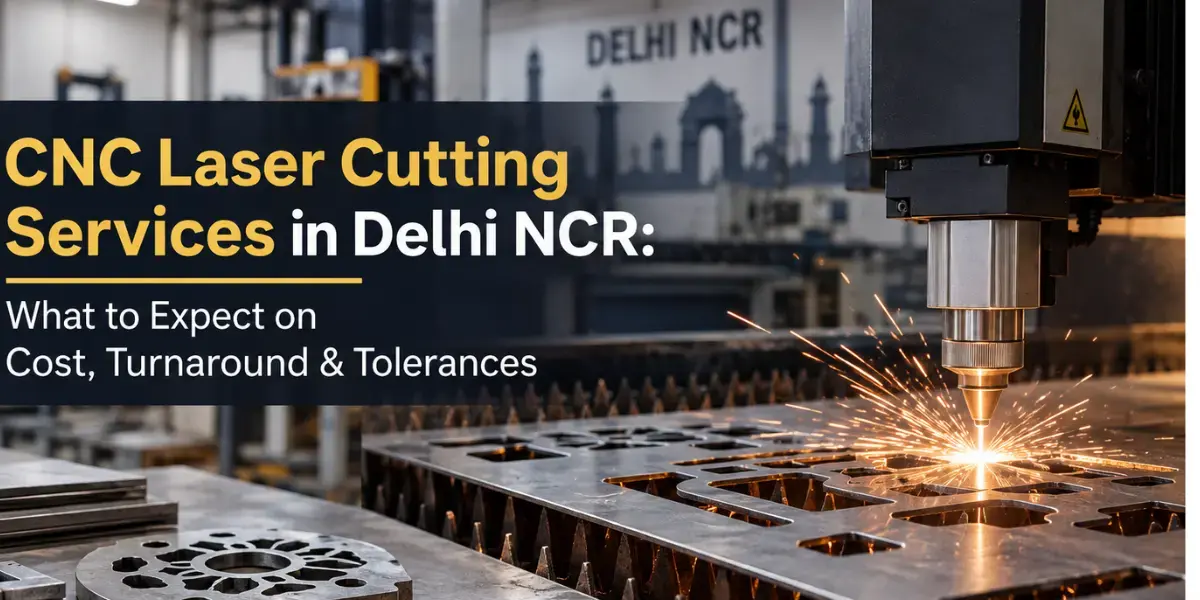
If you’ve asked around Okhla, Wazirpur, or Faridabad for a laser cutting service quote, you already know the problem: two shops can quote wildly different numbers for the same part, and it’s hard to tell whether either one is fair. Tolerances carry a similar trap: specify too tight a number on your drawing and you’ll pay more and wait longer for no real benefit. This guide answers the three questions that shape every CNC laser cutting order in Delhi NCR: what it costs, how long it takes, and what accuracy you can realistically expect.
CNC Laser Cutting in Brief (for Buyers, Not Operators)
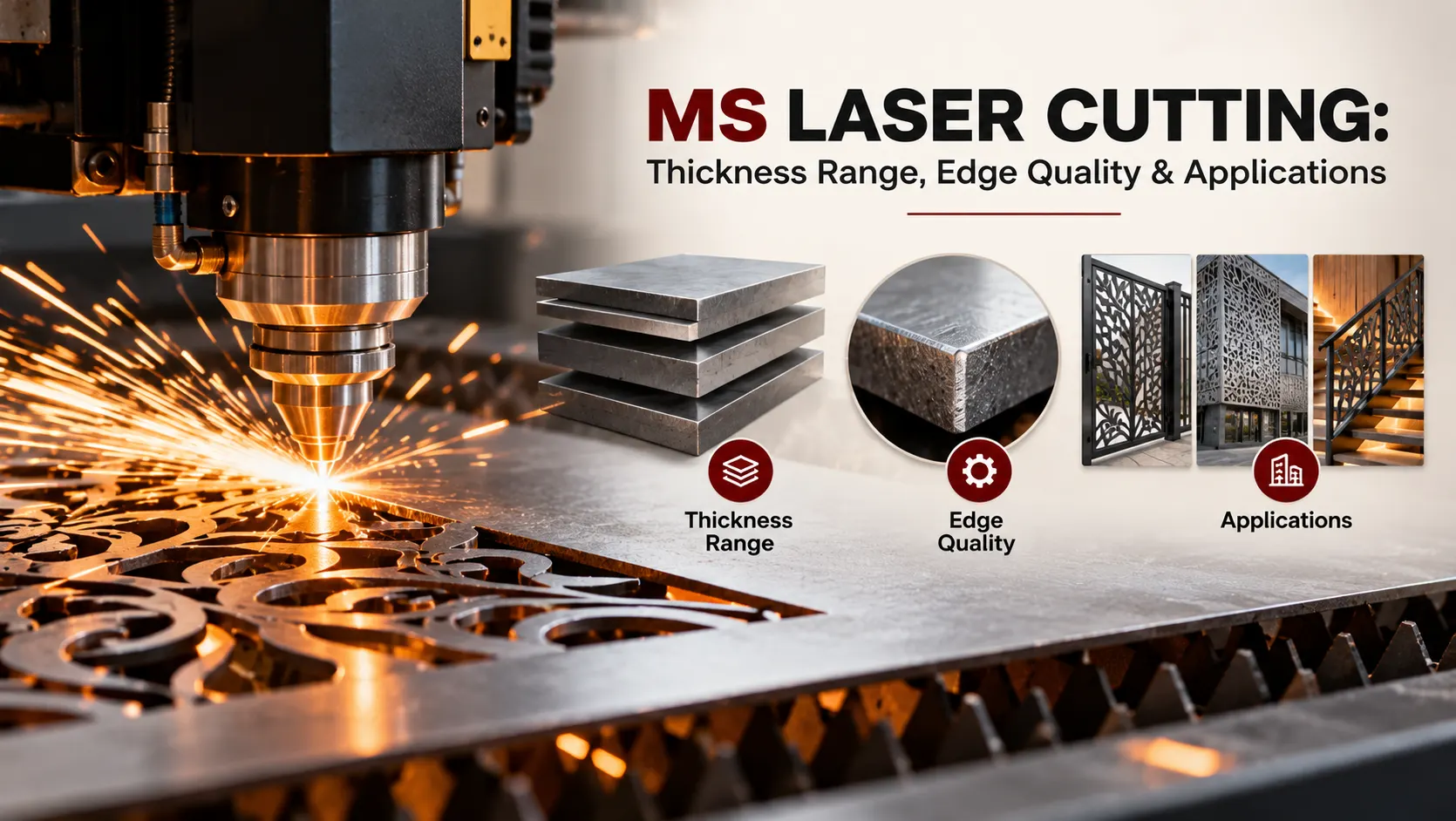
Most Delhi NCR fabrication shops now run fiber lasers, which cut mild steel, stainless steel, aluminium, brass, and copper sheet with a clean, largely burr-free edge and minimal heat-affected zone. Buyers outsource this step because the capital cost, maintenance and skilled operators rarely pay off for occasional or moderate volumes, while a job shop spreads those costs across many customers. For how the process works, see our CNC laser cutting process guide; this article covers cost, turnaround and tolerances.
What CNC Laser Cutting Costs in Delhi NCR
Local quoting practice differs from the generic explanations in global guides, so treat every figure below as an indicative range. Your actual quote is generated from your CAD file, material grade and quantity, not from a price list. Send your file for a quote.
How NCR Shops Quote
Delhi NCR job shops generally price jobs one of three ways: per part (a rate set from each part’s cut length and pierce count), per machine-minute (common for larger or mixed-thickness batches), or per square foot of sheet consumed (common for simple panel or bracket work). Small jobs often see a per-piece rate of roughly ₹15–₹60, while sheet-rate work is quoted per sq ft depending on thickness. Ask which method a shop uses before comparing two quotes – a per-cut price and a per-sq-ft price aren’t directly comparable without doing the math yourself.
Material and Sheet Thickness: The Biggest Lever
Material and thickness drive cost more than any other factor in sheet metal laser cutting. Mild steel is generally the cheapest to cut; stainless steel and aluminium cost more per cut, largely because they are cut with high-pressure nitrogen, which is costlier to run than the oxygen used on mild steel; brass and copper are reflective and command a premium. Within any material, cost rises with thickness. A laser cutting sheet rate for 1mm mild steel tells you little about 6mm plate: thicker material cuts slower and burns more gas per part.
Design Complexity, Pierces & Cut Length
A part with many small holes, tight internal corners, or long total cut length takes more machine time than a simple outline of the same footprint – and machine time is what you’re really paying for. Every pierce adds machine time, and pierce time grows with thickness; a design with 40 pierces will cost noticeably more than one with 4, even on the same sheet area. Nesting efficiency (how many parts fit per sheet) also affects your per-piece cost on larger runs.
Setup, Minimums & Secondary Operations
Expect a minimum order value or setup charge covering programming and machine setup, so very small one-off jobs carry a higher per-piece cost than a batch. If you need bending, powder coating or deburring after cutting, ask whether they’re in-house, since a second vendor adds its own minimum charge and transport.
Turnaround: What to Expect Locally
Turnaround is where Delhi NCR’s dense fabrication ecosystem works in your favour.
Standard Lead Times
Many NCR and Sonipat-belt shops can dispatch (leaving the plant) standard, simple jobs within about 24 hours to nearby industrial zones such as Okhla, Wazirpur, Bawana, Naraina, Patparganj, Noida and Faridabad. For anything beyond a simple, single-material cut, whether larger batches, mixed materials or jobs needing secondary finishing, a more typical quoted lead time is 3–7 days. Treat 24-hour dispatch as the fast-track case, not the default assumption for every job.
What Speeds a Job Up or Slows It Down
Simple geometry, a single material and thickness, and a clean, ready-to-cut DXF or DWG file all help a shop slot your job in quickly. What slows things down: incomplete files or files with CAD errors that need rework before cutting, multi-material batches that require nozzle, gas and parameter changeovers between runs, and any job that needs bending or coating from a second vendor, since that adds a full logistics leg.
Rush Jobs and Expedite Fees
Genuine rush requests are usually possible, but expect an expedite fee, often a percentage premium on the base quote, for jumping the production queue. It’s worth asking upfront rather than assuming rush service is included, especially if you’re quoting multiple shops and comparing turnaround alongside price.
Tolerances: What’s Realistic
Tolerance is easy to overspecify on a drawing, and overspecifying quietly inflates both cost and lead time.
Typical Achievable Tolerance
Delhi NCR fiber laser shops commonly quote cutting accuracy of around ±0.1mm. That is a machine capability, not a drawing standard. ISO 2768-m (medium), the general tolerance class many buyers note in the title block, is looser on most part sizes: ±0.1mm up to 6mm, rising to ±0.3mm for 30–120mm and ±0.5mm for 120–400mm. For most brackets, panels and enclosures, 2768-m is a sensible default because it gives the shop headroom without risking fit.
What Affects Dimensional Accuracy
Actual achievable accuracy depends on more than the machine spec sheet. Thicker material is harder to hold to tight tolerance because the cut kerf and any taper become more pronounced. Heat input during cutting can cause slight thermal distortion, especially on longer or thinner parts, which can pull dimensions outside a very tight spec even on a well-calibrated machine. Material inconsistency – sheet that isn’t perfectly flat or has thickness variation – also shows up in the final part regardless of how good the laser and programming are.
When to Specify a Tight Tolerance – and When Not To
Reserve tighter-than-standard tolerances (tighter than ±0.1mm) for features that genuinely require it, such as a hole that mates with a bearing or shaft, and confirm with the shop whether that feature needs a secondary machining step. Call those features out specifically rather than tightening the tolerance on the whole drawing. Applying a tight blanket tolerance when only one or two features need it is a common way buyers drive up their own quote.
How to Get an Accurate Quote (and Keep Cost Down)
A better RFQ gets you a faster, more accurate quote and avoids the back-and-forth that eats into your turnaround window.
What to include in your RFQ:
- A clean DXF or DWG file (not a PDF or image) with no duplicate or open lines
- Material and grade (e.g., MS, SS304, 6061 aluminium)
- Sheet thickness
- Quantity per part
- Any tolerance callouts that go beyond the ISO 2768-m default
- Required finish or secondary operations (deburring, bending, powder coating)
- Material supplied by you, or by the shop
- Delivery zone and required date
A few design choices can meaningfully lower the number a shop comes back with: simplify geometry and reduce unnecessary pierces where possible, as a common rule of thumb, keep hole diameters at or above the sheet thickness to avoid difficult small-hole cutting, add small radii to sharp internal corners instead of true points, and batch parts together to spread the setup charge across more pieces.
When comparing quotes from different Delhi NCR shops, don’t stop at the bottom-line number – confirm what’s actually included. One shop’s price might exclude deburring or bending that another bundles in, which makes a “cheaper” quote more expensive once you add the missing steps yourself.
Choosing a CNC Laser Cutting Service in Delhi NCR
A few practical checks help separate a reliable local laser cutting service from one that will cause delays. Confirm the shop’s machine power and bed size actually suit your material and thickness – not every machine handles 8–10mm plate well, even if it’s advertised as capable. Look for shops offering in-house secondary operations like bending and powder coating, since a single-vendor workflow avoids the handoff delays of shipping parts between separate finishing shops. Ask too whether the shop offers DFM support on your file before cutting. Finally, a ‘laser cutting near me’ search is a good start, but judge the results on logistics to your own zone: a shop 10 minutes from your Okhla or Faridabad unit can often beat a cheaper, distant quote once transport is counted.
FAQ
How much does CNC laser cutting cost per hour or per cut in Delhi NCR?
Most NCR shops quote per cut, per machine-minute (the hourly rate in effect) or per sq ft rather than a flat published hourly rate, with small standard jobs commonly falling in the ₹15-₹60 per-piece range. The exact figure depends heavily on material, thickness, and design complexity, so treat any number you see online as a starting estimate until you get a quote against your actual file.
What is the difference between the CNC laser cutting machine price and the cost of the cutting service?
A CNC laser cutting machine price refers to buying the capital equipment itself: a one-time capital investment plus installation and maintenance. The cost of a laser cutting service, by contrast, is the per-job price a fabrication shop charges to cut your parts on their existing machine, with no equipment ownership involved. Most buyers with occasional or moderate-volume needs use a service rather than purchasing a machine.
What tolerance can I expect from sheet metal laser cutting?
For standard jobs, Delhi NCR fiber laser shops typically hold around ±0.1mm as a machine capability. ISO 2768-m, a common drawing default, is size-dependent and looser on larger dimensions (±0.3mm at 30–120mm). Tighter tolerances are achievable but should be reserved for specific mating features rather than applied across an entire drawing, since they add cost and lead time.
How do I find a reliable laser cutting service near me in Delhi NCR?
Start by checking that a shop’s machine capability matches your material and thickness, and whether it offers in-house secondary operations like bending or powder coating to avoid multi-vendor delays. Proximity to your own facility also matters for logistics. Check rated thickness per material, ask for DFM file review, and request a sample cut or plant visit, then shortlist three local shops and compare them on scope, not just price.