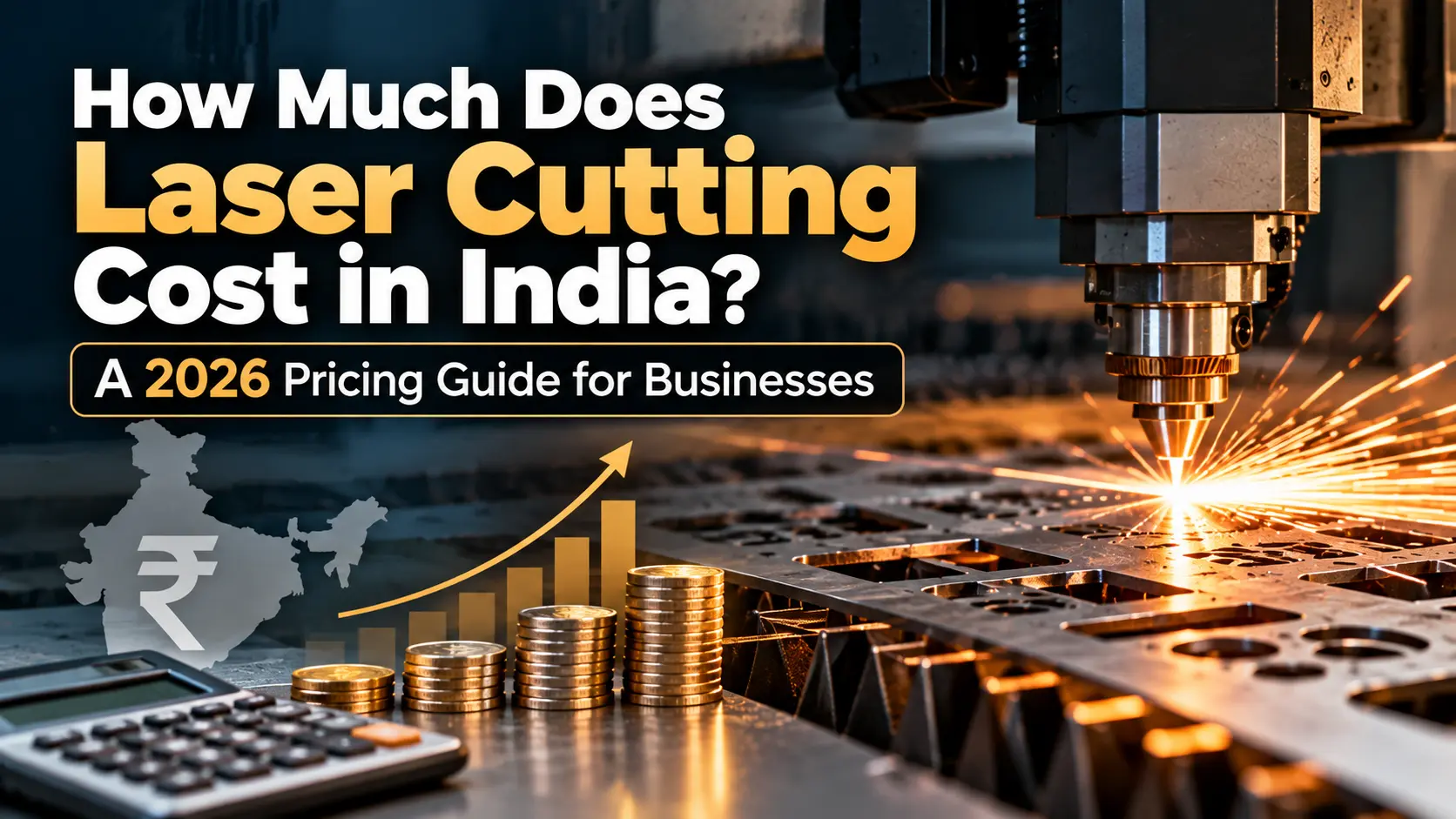
Search for laser cutting machine price and you’ll mostly land on marketplace listings asking you to “get quote” or manufacturer pages nudging you toward their own model. Neither gives you a straight number. The honest answer is that laser cutting cost in India covers two very different questions: what it costs to buy a machine, and what it costs to get parts cut by someone else’s machine. Depending on which one you’re asking, the figure could be a few lakh rupees or several crore.
This guide breaks down both paths with real 2026 rupee ranges, explains what actually pushes the price up or down, and covers job-work cutting rates -a piece most pricing pages skip entirely.
Laser Cutting Machine Price in India: The Price Bands at a Glance
The single biggest driver of laser cutting machine price in india is what the machine is built to cut and how much power it carries. Below is a realistic snapshot of where different machine classes sit today.
Machine class / use case | Typical power | Indicative 2026 price range (INR) |
Hobby/desktop (diode or small CO2, non-metal) | Under 100W | ₹1.5 – 4 lakh |
Small CO2 laser (signage, acrylic, wood, MDF) | 60W – 150W | ₹2.7 – 6 lakh |
Entry-level single-bed fiber (light metal) | 1kW – 2kW | ₹8 – 22 lakh |
Mid-range industrial fiber | 3kW – 6kW | ₹25 – 50 lakh |
High-power industrial fiber | 6kW – 12kW | ₹40 – 80 lakh |
Heavy-duty industrial fiber (thick plate, reflective metals) | 12kW – 30kW+ | ₹1 crore – 4+ crore |
A few things stand out. First, there’s no single “laser cutting machine price” -a signage shop and a heavy fabrication unit are shopping in completely different brackets. Second, the jump from entry-level to mid-range fiber is steep: doubling or tripling the kilowatt rating roughly doubles the price, because you’re paying for a bigger laser source, heavier-duty motion system, and often a bigger cutting bed to match. Third, anything above 12kW is really an industrial capital-equipment purchase, usually with financing, installation, and civil work layered on top of the machine cost itself.
Price by Machine Type: Fiber vs CO2 (and What ‘CNC’ Really Means)
Fiber laser machines (for metal)
Fiber lasers are the default choice for cutting mild steel, stainless steel, aluminium, and other metals. They cost more upfront than CO2 machines of similar bed size, but run cheaper per hour -less power draw, no gas lens or mirror alignment to maintain, and a laser source rated for tens of thousands of hours. In India, this is where fiber laser cutting machine pricing spans the widest range: an entry single-bed unit can start under ₹10 lakh, while a fully automated multi-kilowatt system for a production floor comfortably crosses ₹50 lakh.
CO2 laser machines (for non-metal)
CO2 machines are built for acrylic, wood, MDF, leather, and similar non-metal materials, and occasionally thin non-reflective metal. They’re the cheaper entry point into laser cutting -a capable 100–150W machine with a reasonable bed size is available for a few lakh rupees -but they cost more to run per hour on gas and tube replacement over the machine’s life, and they simply can’t touch thick or reflective metal the way a fiber laser can.
Where ‘CNC laser cutting machine price’ fits
Buyers often search cnc laser cutting machine price to mean any automated, computer-controlled metal-cutting laser -which in practice is almost always a fiber laser system today. Every laser cutter sold commercially in India is CNC-controlled in some form; the term is really shorthand buyers use for automated metal-cutting setups, so pricing here tracks the fiber laser bands above rather than being a separate category.
Price by Bed Size: Why an 8×4 Machine Costs What It Does
Bed size is the second-biggest lever after power, and it’s the reason 8×4 laser cutting machine price in india searches don’t have one clean answer. An 8×4 ft bed (roughly 2500 x 1300mm) is the most commonly asked-about large-format size, since it matches standard sheet stock used in fabrication and signage.
Rough indicative bands by bed size:
- Compact beds (under 1300 x 900mm): lower end of the CO2 and entry-fiber ranges above.
- 3015-class beds (3000 x 1500mm): common for mid-range industrial fiber, roughly ₹25–45 lakh.
- 8×4/6525-class beds: sits close to or just above the 3015 class, typically ₹25–50 lakh for fiber, or a few lakh for CO2 versions used on non-metal.
The reason bigger beds cost more isn’t just the steel and rails -a larger bed usually needs a stronger, higher-power laser source to cut efficiently across the full sheet without slowing down, plus a beefier gantry and motion system to hold accuracy over a longer travel distance. So an 8×4 machine isn’t just “more table,” it’s typically paired with more power too, and that’s what moves the price band up.
Small & Entry-Level Machines: Lower-Budget Options
For businesses that don’t need industrial-scale output, small laser cutting machine price in india starts well under ₹10 lakh. Two categories dominate this end of the market:
- Hobby/desktop diode and small CO2 machines -used for signage, craft, packaging samples, and light engraving on wood, acrylic, or leather. These sit around ₹1.5–4 lakh and are the most accessible entry point into laser cutting.
- Entry single-bed fiber lasers -aimed at small metal fabrication shops that need to cut thin-to-medium gauge sheet (mild steel, stainless steel, aluminium) without the footprint or cost of an industrial system. These typically run ₹8–22 lakh.
The trade-off at this end is real: lower-power machines cut thinner material more slowly, have smaller beds, and often come with lighter after-sales support than industrial-grade suppliers offer. A small business buying the cheapest machine on the list can end up under-equipped for the thickness or volume it actually needs -matching the machine to real job requirements matters more here than at the top end.
What Actually Moves the Price (Buyer’s Checklist)
A handful of specifications explain almost all the price variation you’ll see between quotes for what looks like “the same” machine:
- Laser power (wattage/kW) -the single biggest cost driver; higher power cuts thicker and faster but costs more upfront.
- Bed size -a bigger cutting area needs a bigger frame, motion system, and usually more power to match.
- Laser source and brand -imported sources such as IPG, Raycus, or Max typically carry a premium over locally-sourced or assembled alternatives; country of origin and brand of the whole machine also shift price.
- Automation -auto-loading, auto-unloading, and pallet-exchange tables add significant cost but cut labour time on high-volume jobs.
- After-sales and AMC -warranty length, spare-parts availability, and annual maintenance contract terms affect the total quote, not just the sticker price.
No brand is being recommended here -these are neutral factors any quote should be evaluated against. If a number in a quote doesn’t line up with typical ranges for that spec, it’s worth asking the supplier to explain rather than assuming it’s a bargain.
Not Buying a Machine? Job-Work Laser Cutting Costs
If you just need a batch of parts cut rather than a machine of your own, job-work laser cutting is priced very differently -and this is the gap most pricing pages don’t cover at all.
Job shops typically quote in one of two ways: a flat hourly machine rate, commonly in the ₹500–2,500 per hour range depending on machine power and city, or a per-cut/per-length rate, often a few rupees per millimetre or a per-square-foot charge for sheet materials like acrylic. The exact number depends on material type, thickness, part quantity, and how much cutting time (including pierce points and intricate detail) the job actually needs. Larger batches bring the per-part cost down sharply, since setup and programming time gets spread across more pieces -a single prototype part can cost several times more per unit than the same part ordered in a run of fifty. Rates also vary meaningfully by city and by shop, so it’s worth getting two or three quotes on the same drawing before committing.
Don’t Forget Running Costs
The purchase price is only part of the total cost of owning a laser cutter. Ongoing costs include electricity (fiber lasers draw noticeably less power than CO2 for equivalent cutting work), assist gases -oxygen or nitrogen for metal cutting, compressed air for lighter jobs -and consumables like nozzles, protective lenses, and ceramic parts that wear out over hundreds of cutting hours. Add routine maintenance or an annual AMC on top. None of this shows up on the machine’s price tag, but it adds up over a year of operation and should factor into any buy decision, not just the upfront number.
How to Get the Right Price Without Overpaying
Before signing off on a quote: ask for an itemised breakdown rather than a single lump figure, so you can see what you’re actually paying for. Match the laser’s power to the material thickness and volume you’ll realistically run -buying more kilowatts than your work needs is a common way businesses overspend. Weigh the AMC terms and typical service response time as heavily as the machine price itself, since downtime costs more than a maintenance contract. And if budget is tight, a well-maintained used machine from a reputable seller can be a reasonable way into fiber laser cutting without the full new-machine price tag.
FAQ
What is the minimum price of a laser cutting machine in India?
The cheapest usable machines are small desktop or CO2 units for non-metal materials like acrylic and wood, starting around ₹1.5–2.7 lakh. If you need to cut metal, the minimum realistic entry point is a small single-bed fiber laser, typically starting around ₹8 lakh.
How much does a fiber laser cutting machine cost in India?
Fiber laser cutting machine prices generally range from ₹8–22 lakh for entry-level single-bed models, ₹25–50 lakh for mid-range 3–6kW industrial machines, and upward of ₹80 lakh to several crore for high-power 6kW+ systems with larger beds and automation.
Is fiber or CO2 laser cutting cheaper?
CO2 machines are cheaper to buy -a capable unit can cost a few lakh rupees -but they’re limited to non-metal materials and cost more to run per hour on gas and consumables. Fiber lasers cost more upfront but are cheaper to operate and are the only practical option for cutting metal.
How much does it cost to get laser cutting done per hour?
Job-work laser cutting is commonly billed ₹500–2,500 per hour depending on machine power, material, and city, or priced per length/area for smaller jobs. Rates vary by shop, so it’s worth comparing a few quotes on the same job.
Is a laser cutting machine a good investment for a small business?
It can be, if the volume and material thickness you regularly work with justify the machine’s power and running costs -otherwise outsourcing to a job-work shop may be cheaper until volume grows. Match the machine spec to real, current job requirements rather than buying for hypothetical future work.