Before you send a drawing out for sheet metal laser cutting, two questions decide whether the job is even feasible: is your metal laser-cuttable at all, and does your thickness fall inside a realistic range? Get either one wrong and you’ll either get a rejected quote or a part with a burnt, dross-heavy edge.
Most fabricators run into this the hard way -quoting a job in copper or thick aluminium without knowing the machine has a ceiling well below what it handles in mild steel. This guide answers both parts directly: which common metals can be laser cut, and the per-metal thickness limits for mild steel, stainless steel, aluminium, brass and copper, along with why those limits exist.
Can Every Metal Be Laser Cut?
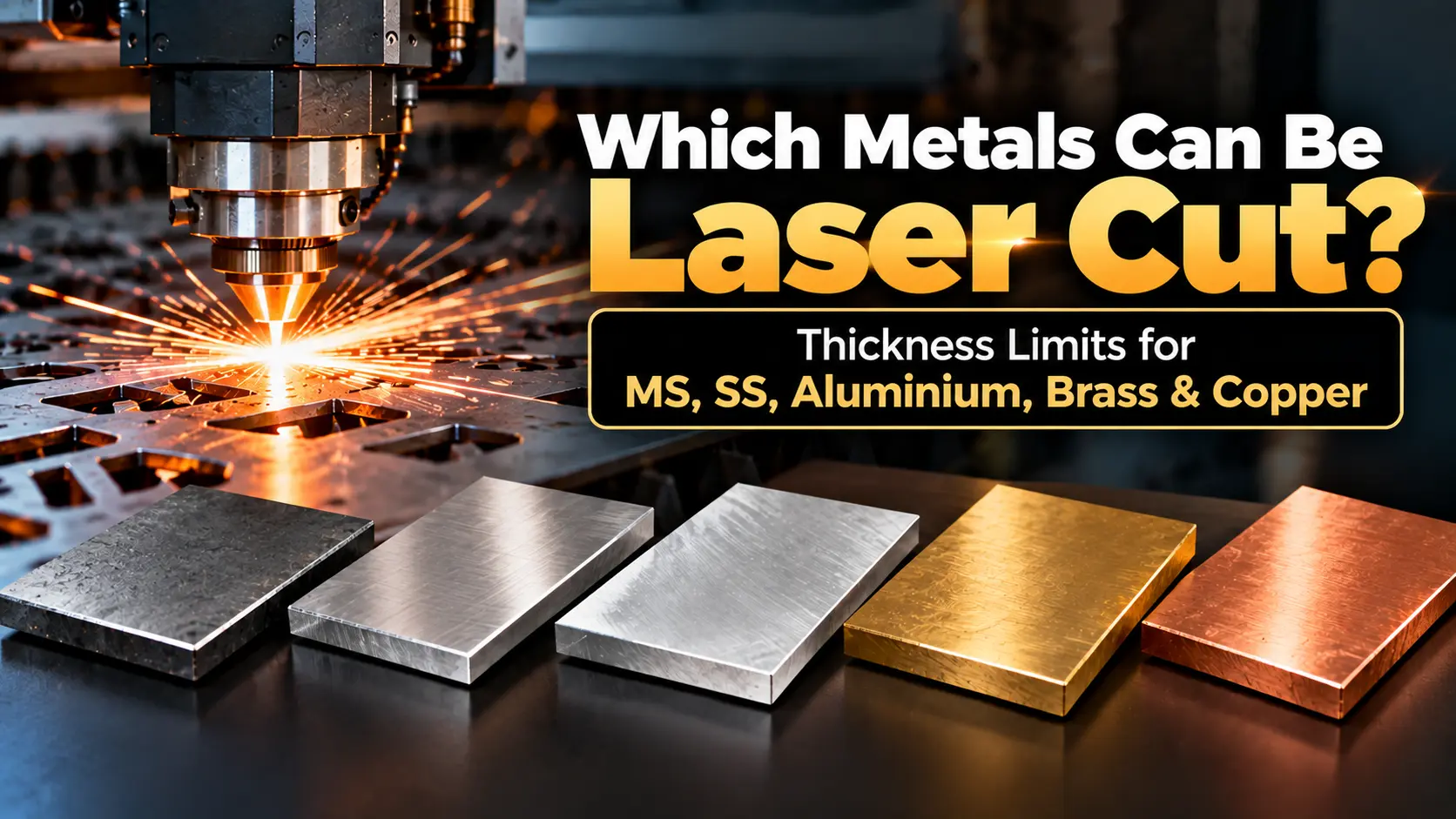
Yes, for practically every metal you’ll meet in general fabrication. Mild/carbon steel, stainless steel, aluminium, brass and copper are all routinely laser cut, along with titanium and nickel alloys in more specialised shops.
The honest caveat: not every metal cuts equally well. Brass, copper, and to a lesser extent aluminium are highly reflective and highly conductive. Reflectivity bounces a portion of the beam’s energy back out of the cut instead of letting it melt through the metal, and high thermal conductivity carries heat away from the cut zone before it can do its job. Modern fiber lasers handle these metals far better than older machines; CO2 lasers, in particular, struggle with brass and copper and are usually avoided for them.
Laser cutting also isn’t the right tool everywhere. Very thick plate -beyond a given machine’s range -is usually better served by plasma or waterjet cutting, and this article stays focused on metals rather than materials that char or release harmful fumes when cut.
One more thing worth knowing before you get to thickness numbers: laser cutting is a CNC process driven entirely by a vector file. The metal and the thickness set the ceiling, but the design of the part -hole sizes, feature spacing, kerf allowance -decides whether you actually get a clean part within that ceiling. More on that below.
Fiber vs CO2: Why It Decides What You Can Cut
The laser type behind a quote matters as much as the metal itself.
Fiber lasers use a shorter wavelength (around 1.06 micron) that metals absorb far more efficiently than CO2 lasers do -especially reflective metals like aluminium, brass and copper. They cut faster and more precisely on thin-to-medium sheet, and they’ve become the default choice for metal cutting in most Indian job shops today.
CO2 lasers use a longer wavelength (10.6 micron) that metals reflect more of. Historically they’ve been noticeably weaker on brass and copper, though they remain useful for some non-metal materials and for shops with existing CO2 equipment.
The thickness figures further down assume a modern fiber laser. If you’re quoting against a CO2 machine or a low-power fiber system, cut those maxima roughly in half, and expect brass and copper to be marginal or unavailable.
Laser type is only half the story, though -power matters just as much. A 1–2kW machine and a 6kW-plus machine have very different ceilings on the same metal, which is exactly what the next section breaks down.
Thickness Limits by Metal: MS, SS, Aluminium, Brass & Copper
The ranges below are typical for a modern fiber laser running at common job-shop power levels (roughly 2–6kW). They’re a planning guide, not a guarantee -actual limits depend on the specific machine’s power, assist gas, and how much edge-quality compromise you’re willing to accept. Always sanity-check against your fabricator’s current machine specs before finalising a job.
Mild Steel (MS / Carbon Steel)
Mild steel is the easiest metal to laser cut and typically has the highest thickness ceiling -commonly up to 20–25mm on a fiber laser in the 4–6kW range, with high-power industrial machines pushing well beyond that. It cuts cleanly because it isn’t reflective and reacts well with oxygen assist gas, which adds its own exothermic heat to the cut. This makes MS the default choice for structural brackets, enclosures, and general fabrication where thickness needs to go beyond what other metals can offer.
Stainless Steel (SS)
Stainless steel typically maxes out around 15–20mm on the same class of machine. It cuts almost as well as mild steel but is usually run with nitrogen assist gas instead of oxygen, to avoid oxidised, discoloured edges -nitrogen means the laser alone has to do the melting, which trims the achievable thickness compared to MS. SS is the standard choice for food-grade, medical, and corrosion-resistant parts.
Aluminium
Aluminium generally tops out around 12–15mm. It’s more reflective than steel and conducts heat away from the cut zone quickly, both of which work against the laser. Nitrogen assist gas is standard here too. Aluminium is common in enclosures, brackets, and lightweight structural parts, but expect rougher edges than steel at comparable thickness, and consider waterjet above roughly 10–12mm if edge finish matters.
Brass
Brass is one of the two most difficult common metals to laser cut, generally limited to around 6–8mm on typical job-shop fiber lasers (higher-power machines, 8kW and up, can push further). Its combination of high reflectivity and high thermal conductivity resists clean melting, and older or lower-power machines may struggle with brass at any meaningful thickness. It’s mostly cut thin, for decorative work, name plates, and electrical components.
Copper
Copper sits alongside brass as the hardest common metal to cut, also typically capped around 6–8mm on standard fiber lasers. Its excellent electrical and thermal conductivity -the very properties that make it useful -are exactly what fights the laser, since heat dissipates away from the cut almost as fast as it’s applied. Copper laser cutting is mostly a thin-sheet process, used for busbars, heat sinks, and electrical contacts.
What Actually Sets the Maximum Thickness (and Design Notes)
Four things determine where the ceiling actually sits for a given job:
- Laser power (kW) -more power melts through more material before the beam loses effectiveness.
- Laser type -fiber vs CO2, as covered above.
- Assist gas -oxygen adds heat for carbon steel; nitrogen gives cleaner, oxide-free edges on stainless and aluminium but does less of the melting work itself.
- The metal’s own reflectivity and conductivity -the property that makes brass and copper harder to cut than steel at the same thickness.
For metal, steel and MS laser cutting design, a few rules keep a part manufacturable within these limits: keep minimum feature size and hole diameter at least equal to the material’s thickness, build in an allowance for kerf (the width the beam actually removes, roughly 0.1–0.5mm depending on thickness and metal), and support small internal “islands” so they don’t shift or fall out mid-cut. Always supply a clean vector file -DXF or DWG -rather than a raster image or a PDF export of one.
Tolerance also isn’t flat across a thickness range. Under ISO 9013, the international standard for thermal-cutting geometry and quality, achievable tolerance tightens on thin sheet -commonly ±0.1–0.2mm up to around 1mm -and loosens as material gets thicker, since more heat disperses into the cut. Design to that reality instead of specifying tighter tolerances than the process can hold.
One last point: thicker isn’t always better handled by a laser. Past a metal’s practical range, edge quality and dross build-up get worse even if the cut technically completes -that’s usually the signal to move the job to plasma or waterjet instead.
Quick-Reference Thickness Table
A fast scan of what each metal can realistically handle on a modern fiber laser, and how easy each one is to cut well.
Metal | Typical max thickness (fiber laser) | Ease of cutting | Note |
Mild Steel (MS) | 20–25mm | Easiest | Oxygen assist; highest ceiling of the five |
Stainless Steel (SS) | 15–20mm | Easy | Nitrogen assist; clean, oxide-free edge |
Aluminium | 12–15mm | Moderate | Reflective and conductive; rougher edge near limit |
Brass | 6–8mm | Hard | High reflectivity; needs higher-power machines |
Copper | 6–8mm | Hardest | High conductivity fights the cut most |
Assumption: modern fiber laser at common job-shop power (roughly 2–6kW). Figures rise with higher power and fall on CO2 or low-power machines.
FAQ
What is the maximum thickness a fiber laser can cut for mild steel?
On common job-shop fiber lasers (roughly 4–6kW), mild steel typically maxes out around 20–25mm, with higher-power industrial machines capable of significantly more. Actual limits depend on the machine’s power, the assist gas used, and how much edge-quality compromise is acceptable near the ceiling.
Why are brass and copper harder to laser cut than steel?
Brass and copper are highly reflective and highly thermally conductive. Reflectivity bounces beam energy away from the cut instead of letting it melt the metal, and high conductivity carries heat away from the cut zone before it can build up. Together, these properties limit both metals to roughly 6–8mm on typical fiber lasers, far below mild steel at the same power.
Can a CO2 laser cut metal sheet?
Yes, but with real limitations. CO2 lasers can cut mild steel and stainless steel reasonably well but historically struggle with reflective metals like brass and copper. Modern fiber lasers have largely replaced CO2 as the default for metal cutting because their shorter wavelength is absorbed far more efficiently by metals.
What file format and design rules do I need for laser cutting a sheet metal part?
Supply a clean vector file -DXF or DWG -rather than a raster image. Keep minimum feature size and hole diameter at least equal to material thickness, allow for kerf (typically 0.1–0.5mm), and support small internal islands.
What is the laser cutting machine price in India?
Pricing varies widely by laser power, bed size, and brand, ranging from budget entry-level fiber systems to high-power industrial machines costing many times more. Because pricing changes with power output and configuration, it’s best checked against current listings rather than a single fixed figure.